

Our padded seat cushions, bench cushions and wall cushions have a foam core. Whether a cushion stays comfortable for years or ends up flattened comes down to this foam core. We use a firm comfort foam with a density of 50 kg/m³ and a compression hardness of 7.8 kPa. Here we explain what these numbers mean and why we chose exactly this foam.
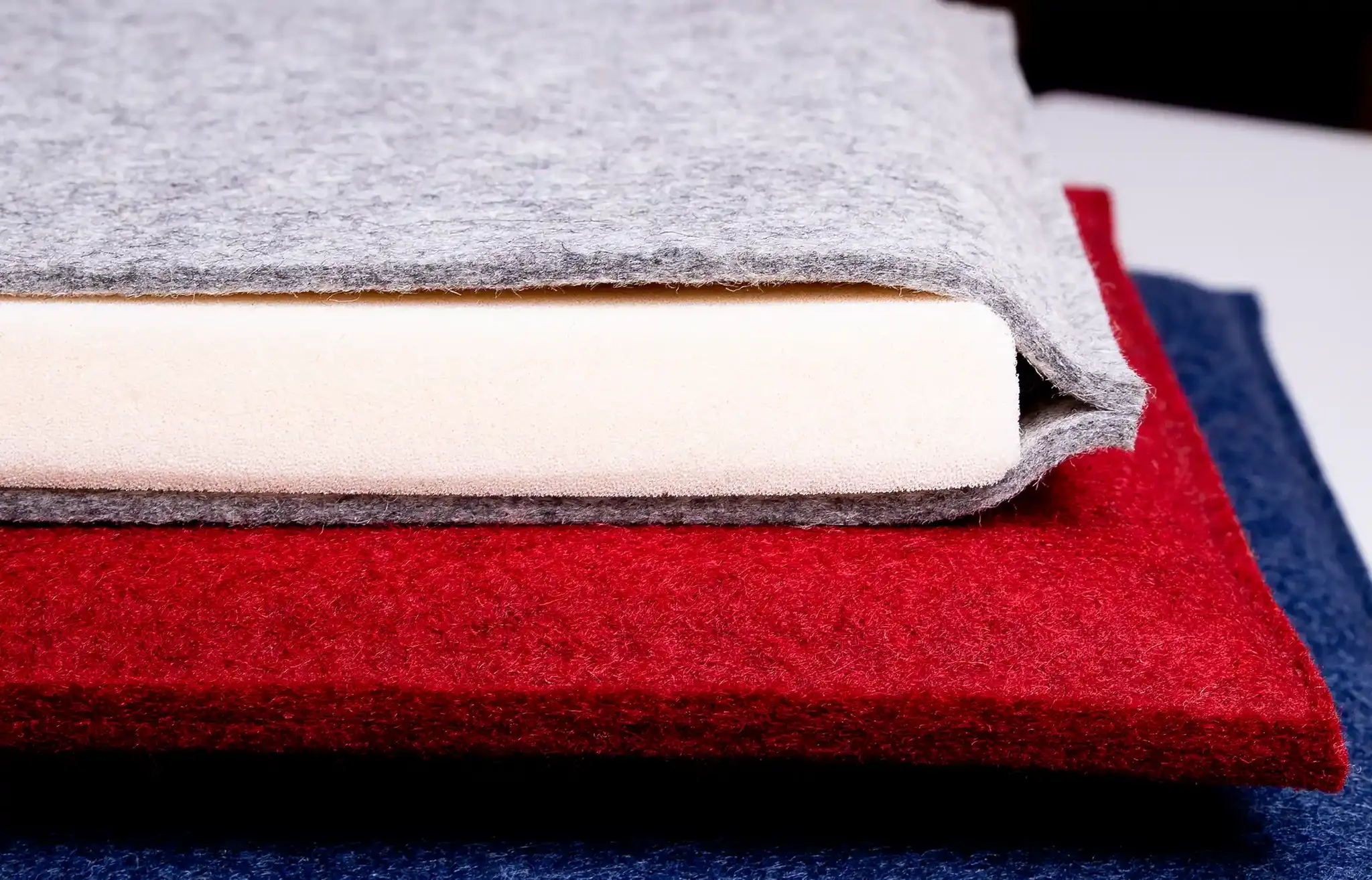
A look inside: 20 mm of comfort foam between two layers of wool felt.
Two numbers that tell you more than any marketing promise
If you want to compare foams, you need two figures: density and compression hardness. They are often combined in a short code – ours is RG 5078.
Density (RG, from the German "Raumgewicht") indicates how much one cubic metre of foam weighs. RG 50 therefore means 50 kg per cubic metre. The higher the density, the more material there is in the foam. This makes it more dimensionally stable and more durable.
Compression hardness indicates how firm the foam feels. It is measured as the pressure in kilopascals (kPa) needed to compress a sample to 40 % of its original thickness. The "78" in our designation stands for 7.8 kPa.
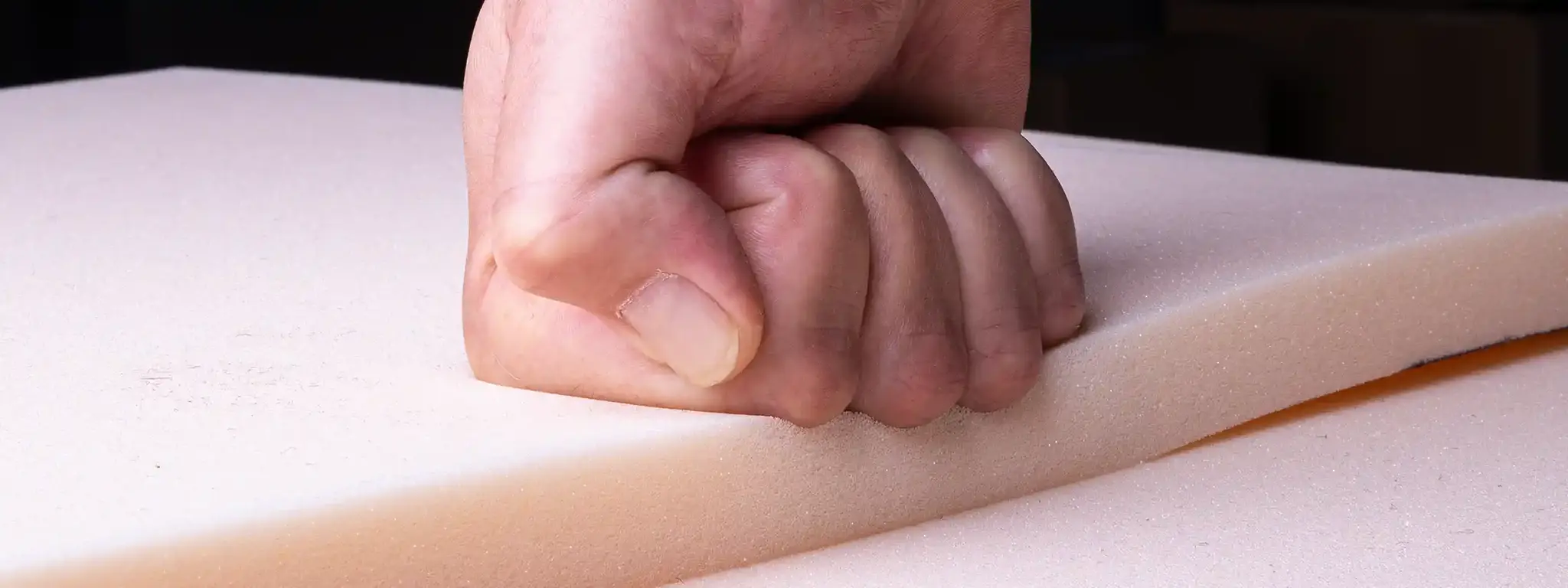
Compression hardness you can feel: you notice right away how firm a foam is.
The most common misconception: heavy foam is automatically hard foam. That is not true. Density and firmness are largely independent of each other. There is heavy, soft foam and light, firm foam. If you only look at one of the two numbers, you only know half the story.
By the way: foam is produced in large blocks, and raw materials and even the room climate play a role in the process. That is why a tolerance of up to ±15 % is normal for both values.
Why a good cushion needs firm foam
A good cushion has to do two things: give when you sit down and still support you. This depends above all on the quality of the foam.
A soft foam would be compressed almost completely when you sit down, and you would basically be sitting on the wood of the bench again. This is known as "bottoming out". Over time it gets worse, because soft foam permanently compacts at the most heavily used spots. Dips start to form.
A firm foam gives noticeably when you sit down, but carries your body weight before it is fully compressed. So even after a long dinner, there is still padding between you and the bench.
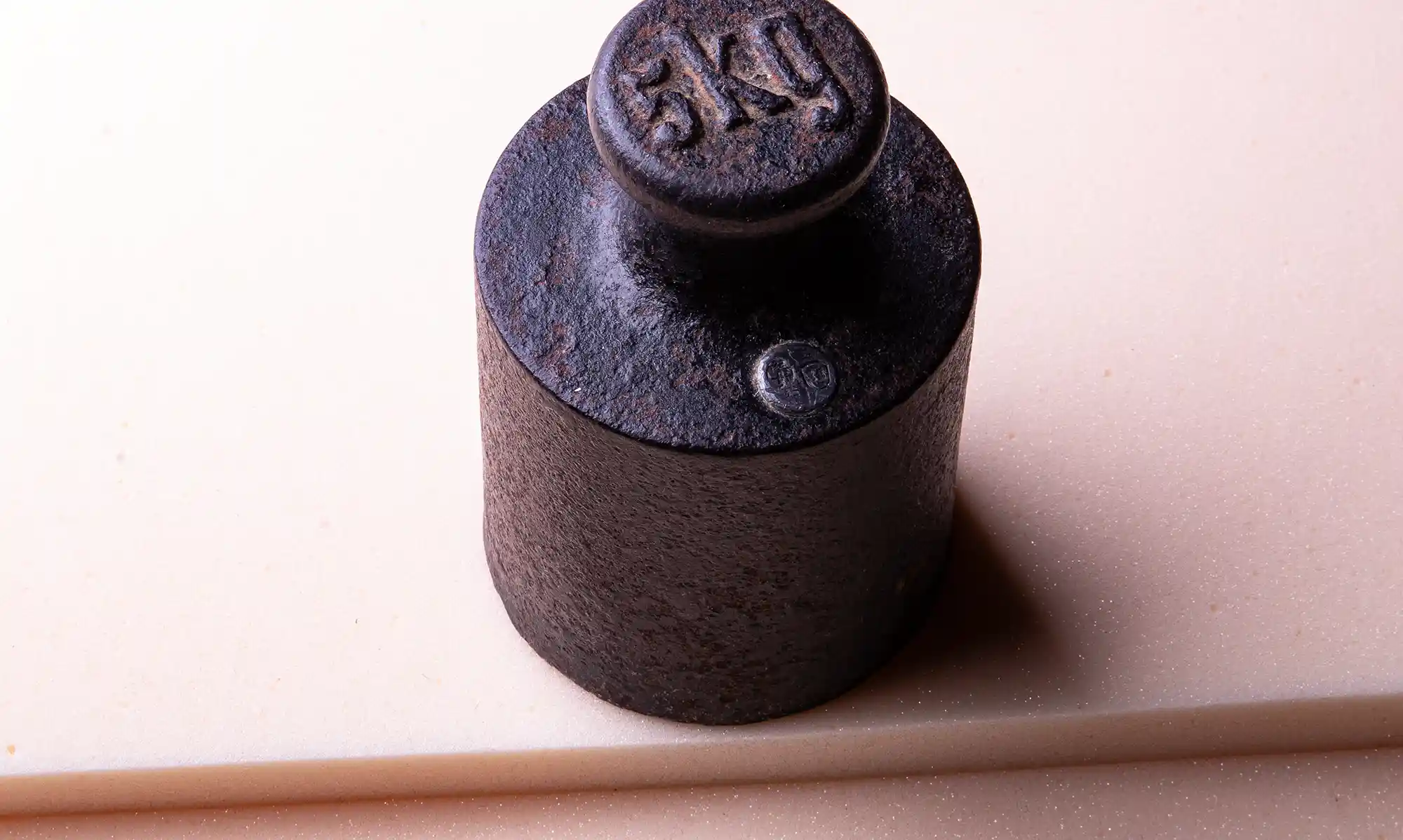
5 kg on RG 50/78: hardly a dent.
How we chose this foam
We tried out different foam qualities in our cushions and tested them in everyday use. Our benchmark was simple: the cushion should give pleasantly when you sit down, support you during long periods of sitting and still look like it did on day one after years of use.
Softer qualities felt cosier at first, but at 20 mm they gave way too quickly. Harder qualities offered good support, but were so firm that the cushion hardly made a difference compared to the bare bench. For us, RG 50/78 was the best balance between comfort and stability.
How RG 50/78 compares
You can't tell how good a cushion is from the outside. It depends on the foam inside.
Seat cushions often contain foam with a density of around 35 kg/m³ and a compression hardness of around 5 kPa. That is a solid standard quality. With RG 50 and 7.8 kPa, our foam is well above that: denser and firmer. The result is a cushion that provides lasting support and keeps its shape.
Common | Our foam | |
Density | approx. 35 kg/m³ | 50 kg/m³ |
Compression hardness | approx. 5 kPa | 7.8 kPa |
Why not upholstery wool, latex or memory foam?
Every filling has its strengths. For a seat cushion that is used every day, firm comfort foam convinced us the most.
Wool filling or upholstery wool sounds like the most natural solution. In upholstery, however, wool is mainly used as an intermediate layer: it sits between the foam or spring core and the cover, rounds off edges, evens out irregularities and protects the cover fabric from abrasion. The support and springiness come from the springs, webbing or foam underneath. As the only filling in a seat cushion, wool does give, but it barely springs back.
On top of that, sitting exposes the wool to pressure, body heat, moisture and friction. These are exactly the conditions under which wool felts. The filling therefore becomes more and more compacted over time, especially where people sit the most. Unlike a pillow, felted wool can't be shaken up or fluffed again, because felting is irreversible. The cushion becomes flatter, harder and uneven. What we deliberately make use of on the outside with our wool felt is a disadvantage inside a cushion.
Our seat cushions don't need this intermediate layer. Upholstery wool normally protects a woven upholstery fabric from chafing against the foam on the inside. Our cover, however, is not a thin woven fabric but dense 3 mm wool felt or leather of around 3.5 mm. Neither material has threads that can wear through, and both are robust enough to lie directly on the foam. No wadding is needed to round off the edges either: the sturdy cover smooths out the cut edges of the foam itself and lies flat over them.
Latex is very elastic and durable. However, it is considerably heavier and more expensive than comfort foam and feels bouncy rather than supportive. We still like to use natural latex: as a non-slip coating on the underside.
Memory foam (viscoelastic foam) adapts to the body and only slowly returns to its shape. It also reacts to temperature: it becomes firm in the cold and soft in the warmth. That is ideal for mattresses. On a bench where you sit down, stand up and shift around, and which may stand in a cold hallway or conservatory in winter, it can hardly play to these strengths.
Firm comfort foam stays dimensionally stable, feels the same at any temperature and springs back into shape immediately when you stand up. That is exactly what a good bench cushion or seat cushion needs.
Yes, there is foam in the core – and here's why
On the outside, we consistently rely on wool felt instead of synthetic fibres. So it's a fair question why there is foam inside. Our honest answer: because it makes the cushion last.
- No abrasion to the outside: The foam is completely enclosed in wool felt. You sit on wool, and only wool wears.
- Long use instead of a throwaway product: A cushion that keeps its shape doesn't need to be replaced after a short time. That saves more resources than any filling that quickly gives way.
- Easy to separate: At the end of its life, the cushion can simply be unpicked at the seam. Felt and foam can then be disposed of separately.
Why long cushions from 205 cm are padded in two parts
Foam is supplied in sheets with fixed dimensions. If a cushion is longer than the sheet, we assemble the padding from two pieces. This applies to cushions from 205 cm in length.
You won't see any of this from the outside: the felt cover is continuous and the seat surface stays even.
In short
- All our seat cushions, bench cushions and wall cushions contain 20 mm of RG 5078 comfort foam: 50 kg/m³ density, 7.8 kPa compression hardness.
- Density stands for durability, compression hardness for firmness. One tells you nothing about the other.
- A good cushion needs firm foam, otherwise you'll soon be sitting on a hard surface again.
- The foam is completely enclosed in the felt and can be separated for disposal at the end.
Want to know where we use this padding? Take a look at our seat cushions, our custom-made felt bench cushion, our custom-made felt bench cushion with quilting, our bench pads and our wall cushions.